Atonement
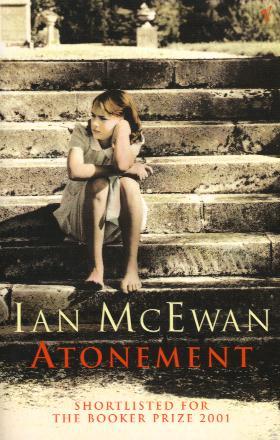 Atonement by Ian McEwan (2001). When Briony Tallis, a precocious adolescent on an English estate, writes a play to mark her brother’s homecoming in 1935, she sets in motion a real-life tragedy that marks the end of her innocence.
Atonement by Ian McEwan (2001). When Briony Tallis, a precocious adolescent on an English estate, writes a play to mark her brother’s homecoming in 1935, she sets in motion a real-life tragedy that marks the end of her innocence.
 Bhagavadgita (fifth century b.c.e.). An eighteen-chapter section of the Mahabharata, this “Song of God” is a dialogue between Prince Arjuna, a warrior on the battlefield, and the Supreme Lord Krishna, who appears as a charioteer. The two discuss the true self that is not destroyed in death and states of release from the human realm of suffering.
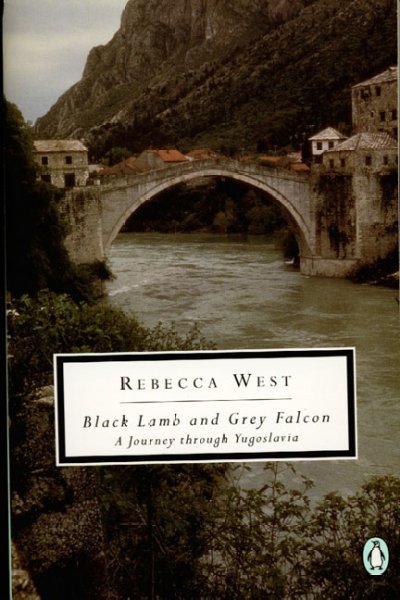 Black Lamb and Grey Falcon: A Journey Through Yugoslavia by Rebecca West (1941). While England slept, West clearly saw the danger of Hitler, who embodied for her the “genius of murder which has shaped our recent history.” Her account of a trip from Dalmatia to Kosovo reads like the cry of a modern Cassandra.
 Bleak House by Charles Dickens (1853). Dickens is best known for his immense plots that trace every corner of Victorian society, and Bleak House fulfills that expectation to perfection. The plot braids the sentimental tale of an orphan unaware of her scandalous parentage with an ironic and bitterly funny satire of a lawsuit that appears to entail all of London.
 Blithe Spirit by Noël Coward (1941). As the Nazis bore down on Britain, Coward filled London theaters with this gay and witty farce about death. The sublime silliness begins when a writer holds a séance to research his novel on a murderous fake psychic. Who should appear but his first wife, dead these six years and none too happy about wife number two.
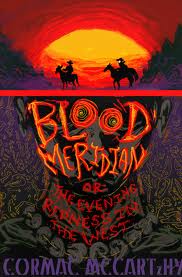 Blood Meridian: Or the Evening Redness in the West by Cormac McCarthy (1985). D. H. Lawrence famously remarked that the archetypal American hero was a stoic, a loner, and a killer. Cormac McCarthy’s tale of the formation and dissolution of a band of scalp hunters in northern Mexico in the late 1840s embodies that dire maxim.
 Bluebeard by Kurt Vonnegut (1987). On one level this is a wickedly hilarious satire of the world of art. Yet, it is also a heartfelt story of American dreams, as a minor artist, whose lack of confidence led him to put down his brush and start collecting other people’s work, looks back on his life, analyzing his high points and low.
 Borderlands/La Frontera by Gloria Anzaldúa (1999). The author uses poetry and prose—mythology, history, memoir—in this passionate account of two types of borders. The first is the physical one between Texas and Mexico. The second is psychological, mapping borderlands defined by sex, race, class, culture, and religion.
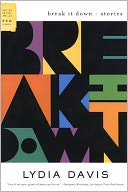 Break It Down by Lydia Davis (1986). Through crisp, propulsive sentences laced with knowing irony, Davis plunges readers into various streams of consciousness in her debut collection. Ideas rather than action animate these thirty-four stories—some no more than a paragraph long, most set in a character’s racing, obsessive mind.
 Breaking and Entering by Joy Williams (1988). A teenage couple breaks into empty vacation homes in Florida to live “the ordered life of someone else. . . .